(And What They Really Cost You)
A few years ago I walked a 32-unit property with a an investor and the seller who kept saying the same thing every time I paused near a wall, a panel, or a drain: “That’s nothing, it’s always been like that.” By the third time I heard it, I stopped believing him.
Sure enough, the inspection came back ugly — a stucco crack over the west wing turned out to be years of water intrusion into the sheathing, the electrical panel was a 100-amp original from the 1970s feeding units that now each ran central air, and the basement mechanical room had a permanent puddle that the seller said ‘is no big deal, always been there.’
Walking many deals like this has taught me something every multifamily investor eventually learns the hard way: the items that look cosmetic are rarely the expensive ones, and the items nobody mentions on a walkthrough are usually the ones that blow up your capital reserve.
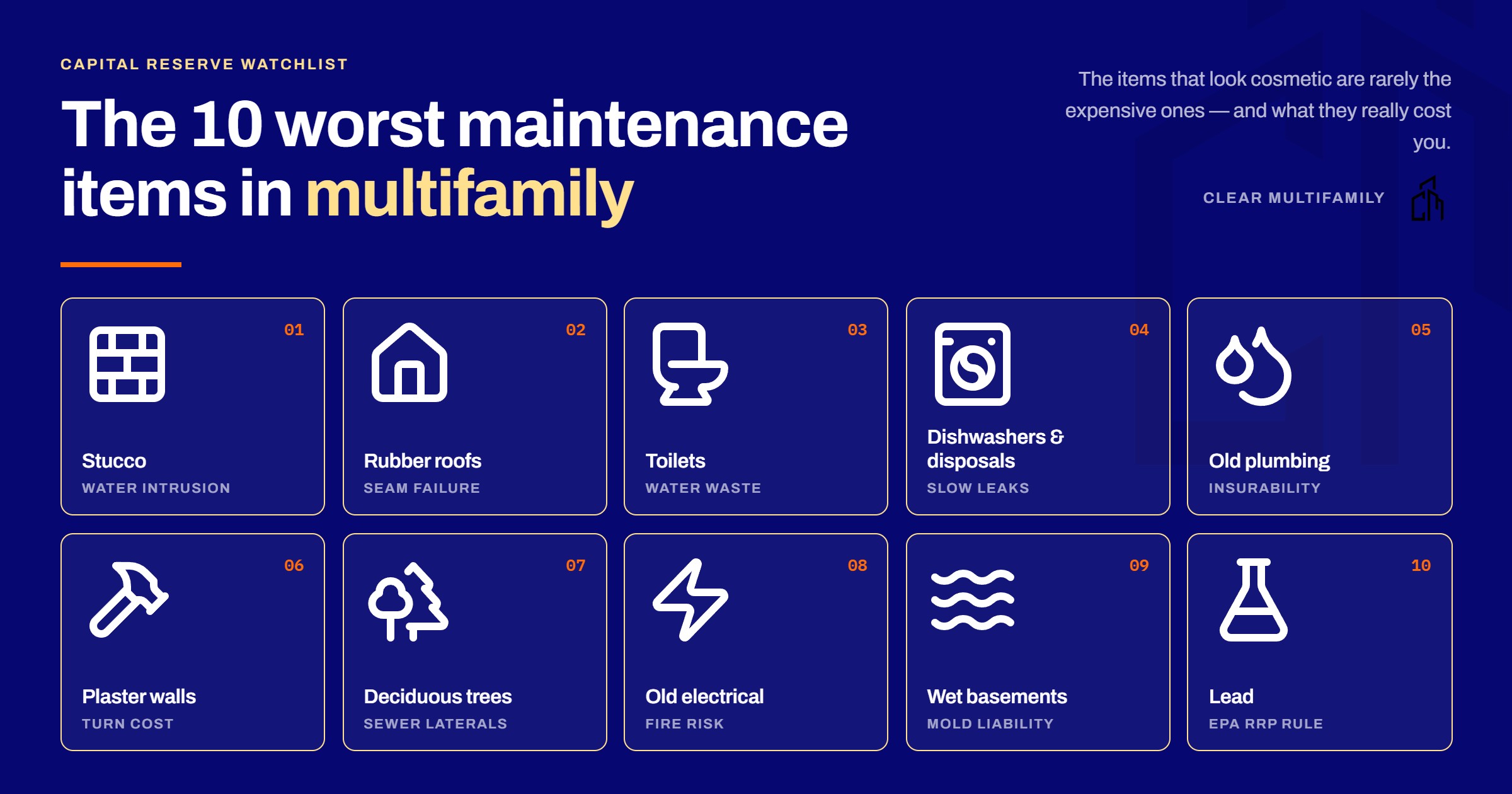
After years of underwriting, touring, and selling multifamily assets, here are the ten maintenance items that consistently do the most damage to NOI, insurability, and peace of mind — and what to watch for before you close.
1. Stucco
Stucco looks bulletproof and hides moisture problems better than almost any other exterior finish. Cracks, especially around windows and rooflines, let water behind the cladding where it sits against sheathing and framing unnoticed for years. By the time staining or bulging shows up on the surface, you’re often looking at wall-cavity rot, not a patch job.
- Preventative maintenance checks is a smart move to keep issues from developing into larger ones. Budget accordingly.
2. Rubber Roofs
EPDM (rubber) roofing is common on garden-style and low-rise multifamily buildings because it’s inexpensive to install — but seams are the weak point, and ponding water accelerates failure well before the advertised 20-year lifespan. Leaks can commonly develop around seams and do quick damage to units underneath.
- A rubber roof nearing 15 years should be treated as a near-term capital item in your underwriting, not a “still fine” line item.
3. Toilets
Nobody budgets much for toilets, and that’s exactly the problem. Old flappers, fill valves, and flush mechanisms waste enormous amounts of water across a multi-unit property, and if you’re on RUBS or paying water directly, a handful of silently running toilets can quietly erode your margins month after month.
Toilets also incur repeated maintenance costs from people flushing things down that should not be. While not everything is controllable (speaking as a parent who had a child who loved to flush his toys down the toilet) making sure your tenants know what should be flushed (TP only!) and should not (everything else!) can go a long way.
- Consider upgrading to newer, low use models to save on water and service calls.
4. Dishwashers and Garbage Disposals
These are maintenance nightmares. Disposals jam, leak, and get abused by tenants who put things down them that should never go near a blade. Dishwashers fail quickly (faster than my daughter goes through boyfriends) with slow leaks that damage cabinetry and subfloor long before a tenant reports it.
- Do yourself a favor and just don’t on these, unless you are providing Class A units and a dishwasher is expected.
5. Old Plumbing
Galvanized steel corrodes from the inside out, restricting flow and eventually pinholing into leaks you can’t see until there’s water damage below. Older cast iron waste lines and 1980s-era polybutylene supply lines carry similar risk.
- Beyond the repair cost, aging plumbing systems are increasingly a red flag for insurers and lenders — some carriers now require a plumbing update as a condition of coverage. When doing a reno, go ahead and replace where ever you can, and the long term investor in you will thank your current self later.
I once had a plaster ceiling that fell down onto a tenant’s bed (thankfully they were not in it) because of the leaking for an old pipe in the ceiling above it. Fun times. That brings us to #6!
Watch: 10 Maintenance Costs That Can Kill Your Multifamily Investment
Watch: The 10 Worst Maintenance Items in Multifamily Properties
6. Plaster Walls
Charming in a prewar building, expensive everywhere else. Plaster cracks with settling, is far more labor-intensive to patch than drywall, and rarely matches perfectly when repaired — which slows down unit turns and adds cost to every make-ready.
- While throwing up drop ceilings is a solution a lot of investors turn to for cracking plaster, taking the time to replace or repair correctly will provide a higher quality rental. Plaster can be repaired well by a qualified professional. Budget accordingly.
7. Deciduous Trees
Beautiful landscaping, expensive root systems. Mature trees near a property routinely infiltrate sewer laterals, and their leaf drop clogs gutters and area drains every single fall, which contributes directly to items 2 and 9 on this list. That’s also before we talk about storm damage when a limp comes down on your property….(no, I don’t want to talk about it..)
- Root barriers, sewer pipe linings, and a real landscaping maintenance schedule with trimming are cheap insurance against a much larger repair. Or just cut the beauty down and plan some new goodness far away from any real estate you own.
8. Overloaded or Outdated Electrical Systems
Fuse panels, knob-and-tube wiring, and undersized services were fine when units had a refrigerator and a lamp. They are not fine now that tenants run central air, multiple devices (yikes electric scooters!), and increasingly EV chargers. Beyond fire risk, outdated electrical is one of the fastest ways to get a policy non-renewed or hit with a costly underwriting requirement.
- Save yourself the problem later and upgrade those electric panels. Doing a panel at every turn is an easy way to track this process until complete.
9. Wet Basements
Foundation cracks, failed sump pumps, and poor exterior grading turn basements and mechanical rooms into standing moisture problems — and standing moisture becomes mold, which becomes a liability and habitability issue fast. Wet basements are also one of the most commonly under-disclosed issues on a walkthrough, because the smell fades and the stains get painted over before a showing.
- Often addressing the grading and gutters around a property can go a long way to dry basements. While it seems harmless, only your grandma’s house that was built over a natural spring truly should have water in the basement.
10. Lead
Any property built before 1978 carries potential lead-based paint exposure, and older municipal systems may still have lead service lines feeding the building. Beyond the health liability, there are real disclosure and remediation obligations — the EPA’s RRP rule governs how contractors must handle renovation in these properties, and getting this wrong can expose an owner to significant legal and financial risk.
- Many municipalities are now bringing Lead based paint remediation requirements to Landlords. If it has not come to your property yet- it likely will, so remediating old chipping paint, wrapping window sills, replacing Lead pipes will be measures that will be targeted.
The Bottom Line
Every experienced investor likely has a story about some, or all of these items. What do you think are the worse offenders, and your favorite trick to fix them? Tell me your stories!
Many investors we work with have an experience to share about these items because they learned the hard way. Don’t let that be you. Learn the easy way by following us and staying in touch here on our social:
–https://www.linkedin.com/company/clear-multifamily
https://www.instagram.com/clearmultifamily
https://www.facebook.com/profile.php?id=61591852917297
If any of these issues sound familiar, or you’re not sure how much life is left in your roof, panels, or plumbing, reach out to our team and we can walk through what to prioritize before it becomes a bigger problem.