
One of my personal friends hates real estate. Too much work, too much hassle — why bother, he says, when you can make the same return in the stock market?
Naturally, I’m always talking up how great real estate is. But his reply to pacify me is usually, ‘I’ll just buy a REIT and save myself the stress.’
But part of what I love about real estate is the tax savings. Are REITs as tax-efficient as direct real estate ownership? Let’s explore.
Real Estate Investment Trusts (REITs) are a popular choice for investors like my friend, seeking exposure to real estate without the burdens of direct ownership. One important feature of real estate investing is depreciation, a tax-deductible expense that allows property owners to write off the cost of buildings and improvements over time.
But how does depreciation work in a REIT structure, and what happens to those write-offs?
While a steady flow of payments may sound enticing, REIT dividends come with unique tax consequences for investors. These payments can constitute ordinary income, capital gains, or a return of capital — each receiving different tax treatment. Below, we explain how REITs work and what investors should know about the potential tax implications.
Understanding REITs
A REIT, by definition, is a corporation that owns and operates income-producing real estate and meets certain IRS requirements, such as distributing at least 90% of taxable income as dividends. A REIT is exempt from corporate taxes provided it meets those distribution requirements and follows the investment criteria of holding 75% or more of its assets in real estate. Like other real estate owners, REITs claim depreciation on their properties to reduce taxable income.
REITs function similarly to mutual funds but focus on real estate rather than stocks and bonds. They pool capital from many investors to acquire, manage, and develop diverse types of properties. Investors benefit from REITs in two primary ways: regular dividend payments and potential appreciation of the REIT’s share value.
REITs are available in more than 40 countries and represent trillions in market capitalization, attracting investors seeking higher yields than those available in traditional fixed-income markets like bonds.
The versatility of REITs is evident in their wide range of properties — from apartment complexes and office buildings to more specialized assets like data centers, healthcare facilities, and even timberland. REITs offer exposure to virtually every sector of the real estate market. Some specialize in specific property types, while others maintain diversified portfolios.
Taxation for Unitholders
The dividend payments REIT investors receive fall into three categories: ordinary income, capital gains, and return of capital. This is all broken down on the 1099-DIV that REITs send to shareholders yearly.
Ordinary income: generally, the bulk of the dividend is treated as ordinary income to the investor, taxed according to their marginal tax rate. The portion of a REIT dividend attributable to income may receive further preferential tax treatment thanks to the 20% deduction for qualified pass-through business income, including qualified REIT dividends — this deduction, made permanent under the One Big Beautiful Bill Act (OBBBA), continues to reduce the effective tax rate on this portion of REIT income.
Capital gain or loss: this occurs when the REIT sells property held for at least one year. The capital gain or loss passes through to the investor, taxed at 0%, 15%, or 20% depending on the investor’s income level for the year the gain was received.
Return of capital: depreciation affects REITs differently than direct real estate ownership. Because REITs must distribute most of their taxable income as dividends, depreciation can reduce the taxable income a REIT reports, allowing it to distribute more cash not subject to tax. Because of a REIT’s structure as a corporation, the depreciation deduction can’t ‘pass through’ to the investor the way it would if the investor owned the property directly through an LLC.
For this reason, part of the dividend may be listed as a nontaxable return of capital on an investor’s 1099-DIV. This can happen when a REIT’s cash distributions exceed earnings, for example when the company takes large depreciation expenses. Two things to note about a return of capital:
- This portion of the dividend isn’t taxable in the year it’s paid to the unitholder — it’s taxed later.
- A return of capital lowers the unitholder’s cost basis. When the investor sells their units, this payment is taxed as either a long- or short-term capital gain or loss. If enough capital is returned and the cost basis falls to zero, any further non-dividend distributions are taxed as a capital gain.
On REIT financial statements, depreciation reduces net income, but this accounting treatment doesn’t affect the REIT’s cash flow — which is why investors often focus on Funds From Operations (FFO) rather than net income when evaluating REIT performance.
Watch: Do REITs Have Tax Benefits Like Stocks or Direct Real Estate Ownership??
Example of Unitholder Tax Calculation
An investor buys shares of a REIT trading at $20 per unit. The REIT generates $2 per unit from operations and distributes 90% (or $1.80) to unitholders. Of this, $1.20 of the dividend comes from earnings, while the remaining $0.60 comes from depreciation and other expenses and is considered a nontaxable return of capital.
The investor pays ordinary income tax on the $1.20 in the year it’s received. Meanwhile, the investor’s cost basis is reduced by $0.60, to $19.40 per share. This reduction in basis will be taxed as either a long- or short-term gain or loss when the units are eventually sold.
How Are REITs Taxed Compared to Common Stock?
Most REIT dividends are taxed as ordinary income at the investor’s marginal tax rate, rather than the lower qualified dividend rate that applies to dividends from regular stock holdings. When an investor sells REIT shares, any appreciation is also subject to capital gains tax.
The reason REIT dividends are taxed at the investor’s marginal rate instead of the lower qualified dividends rate is double taxation — a standard corporation pays tax at the corporate level first, which is why investors are permitted a lower rate on those dividends. Since REITs pass through profit without paying corporate tax themselves, the investor pays tax on the income at their standard rate, the same rate they’d pay on real estate investment income held directly.
Remember that some REIT distributions may be classified as a return of capital. These aren’t taxed immediately, but instead reduce the investor’s cost basis in the REIT shares — which can result in higher capital gains tax when the shares are eventually sold.
How Is a REIT Taxed Compared to a Private Real Estate Fund?
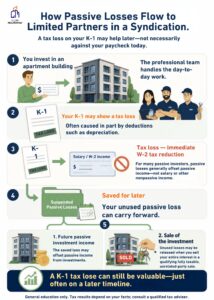
REITs and private real estate fund models differ mainly in ownership structure. A REIT is a corporation that distributes dividends to investors on Form 1099-DIV, with income and expenses calculated at the REIT level and 90% of taxable income paid out. Fund models are usually LPs or LLCs that act as pass-through entities, providing K-1 statements to shareholders, with all profit and loss passed through directly.
Because of the requirement to distribute returns, and the limited ability to pass through depreciation write-offs, REITs usually invest in larger, stabilized properties. Private funds set up to invest in real estate generally focus on value-add opportunities to maximize returns and provide tax write-offs to their investors.
So while investors in private real estate or syndications may get to claim depreciation directly on their tax returns, REIT shareholders don’t. However, they still may benefit indirectly through more tax-efficient dividend distributions.
Conclusion
Understanding how depreciation functions within a REIT is key for investors comparing real estate investment options. Those seeking direct tax benefits from depreciation may prefer private real estate investments or syndications, while those favoring liquidity, diversification, and simplicity often find REITs to be an efficient vehicle, with tax advantages baked in through smart accounting and tax strategy.
Many of our clients appreciate the diversification we advise, so they have consistent cash flow from many sources. If you’re ready to take the next step in your real estate journey, contact us to schedule a strategy call.