Do you want to be a passive real estate investor? What is the best way to do that? If you like the idea of investing in real estate, but don’t want the hassle or have the time to be actively involved, then passive options can meet your goals.
Harry was an investor in his 60s who wanted to spend more time in Kentucky with his race horses, and less time managing his apartments. He had spent many years building up a large portfolio of real estate, and loved the whole process and the thrill of a good win. But after one tenant call too many, he decided to sell the apartments. While glad to be rid of the day-to-day hassle, the time he had spent studying real estate left him longing for a good real estate option to replace his apartment income.
Enter the passive investment — riding in as a winning horse for Harry.
Real Estate Investment Trusts (REITs)
A Real Estate Investment Trust, or REIT, is a company that owns, operates, or finances income-generating real estate across various sectors such as residential, commercial, or industrial. Investors can buy shares in a publicly traded REIT, providing them with a proportional ownership stake in the underlying real estate portfolio. Here are some key features and considerations of REIT investments.
Upside
- Liquidity and Accessibility: REITs are publicly traded on stock exchanges, offering investors high liquidity. This means that shares can be bought or sold easily, providing flexibility for investors to enter or exit their positions.
- Diversification: REITs often own a diverse portfolio of properties, spreading risk across different types of real estate assets. This diversification can be appealing to investors looking for exposure to various segments of the real estate market without having to directly manage individual properties.
- Passive Income: One of the primary attractions of REITs is the potential for regular income distribution. REITs are required by law to distribute at least 90% of their taxable income to shareholders in the form of dividends, offering investors a reliable income stream.
Downside
Tax Benefits: REITs do not offer investors the benefits of passive tax deductions. Since these are treated as a security instead of direct real estate ownership, REIT share owners can miss out on this benefit of real estate. This may not matter if held in a retirement account, so REITs may be a better fit here, since your retirement account is growing tax-sheltered anyway.
Real Estate Syndications
Real estate syndications involve a group of investors pooling their resources to invest in a specific real estate project. This form of investment is often structured as a limited partnership or LLC, with one or more sponsors managing the project. Here are some key features and considerations of real estate syndications.
Watch: REITs vs Real Estate Syndications: What’s the Difference?!
Upside
- Direct Ownership and Possible Control: Unlike REITs, investors in real estate syndications have direct ownership in the underlying real estate asset. The level of control is likely correlated to how large a percentage an investor owns. If an individual investor owns a large percentage of the equity, they can expect to have a greater role to negotiate for direct control of the property, and involvement in decision-making processes related to the property.
- Potential for Higher Returns: Real estate syndications may offer the potential for higher returns compared to REITs. This is because investors participate in the success of a specific project, and if the project performs well, the returns can exceed what a diversified REIT might offer.
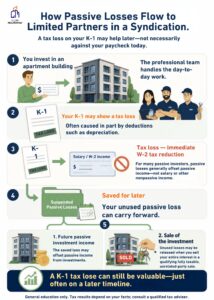
- Tax Benefits: As an active investor in a syndication, the tax benefits can become significant. This can vary based on how your operating agreement is structured, so make sure to pay attention to this in your due diligence. If the property has done a cost segregation study, the tax benefits can exceed income and may reduce the investor’s overall tax liability.
Downside
- Lack of Liquidity: Investments in real estate syndications are less liquid than REITs. Investors typically commit their funds for a specified period, and it may not be easy to sell or exit the investment before the project is completed.
- Hard to Do a 1031 Exchange: Many syndications are set up as partnerships or LLCs, which don’t allow for a direct 1031 exchange. There can be exceptions to this, but it is not frequent because of the additional structure that needs to be put in place for the ownership to allow for an exchange.
NOTE: If you are like Harry and want to sell real estate and get into something passive, but don’t want the tax bill and need to do a 1031 exchange, then consider a Delaware Statutory Trust (DST). This entity structure often is set up to allow for 1031 exchanges, being like a syndication but set up to allow for an exchange.
Conclusion
Both REITs and real estate syndications have their merits and drawbacks, and the choice between them depends on individual investor goals, risk tolerance, and preferences. Ultimately, investors should carefully assess their financial objectives and consult with financial and tax professionals before deciding which avenue aligns best with their investment strategy.
Have a real estate investing question? Contact us anytime.