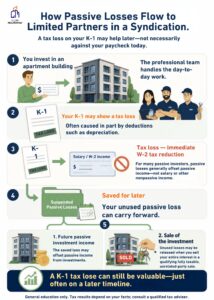

The ink is drying on the check you just wrote to your retirement account, to maximize your deductions for last year’s tax bill.
Now, where will you invest that money? Investors are often encouraged to invest self-directed retirement funds into syndications, as a way to benefit from real estate without all the work.
However, one of the biggest benefits of investing in real estate is the tax write-off, which may be limited if an investor places retirement account assets in real estate.
Understanding Depreciation in Real Estate
Depreciation allows property owners to account for the wear and tear on an asset over time. The IRS permits real estate investors to depreciate residential rental properties over 27.5 years and commercial properties over 39 years. This deduction can offset rental income, reducing the taxable income of the investor. (Multifamily properties with 5+ units are depreciated over 27.5 years, even though they’re considered ‘commercial’ for loan purposes.)
In a real estate syndication, depreciation is distributed among investors based on their ownership interest, or as outlined in the operating agreement. Typically, depreciation is allocated based on the cash investment in the deal, though other methods exist.
Methods of Allocating Depreciation
Depreciation is typically allocated to investors in a syndication in the following ways:
1. Pro-rata share allocation. Most real estate syndications allocate depreciation based on the investor’s percentage of ownership in the entity. For example, if an investor owns 10% of a syndication, they receive 10% of the depreciation deductions. This method ensures an equitable distribution of tax benefits in proportion to the investment made.
2. Preferred return vs. common equity structure. Some syndications have a tiered investment structure where preferred investors receive priority returns, while common equity investors participate in residual profits. In such cases, depreciation may be weighted differently to favor investors who contributed more capital or took on greater risk.
3. Special allocations in the operating agreement. The operating agreement of a syndication can specify customized depreciation allocations. For instance, the general partner (GP) may receive a different proportion of depreciation deductions than limited partners (LPs).
- Special allocations must be written into the operating agreement and have ‘substantial economic effect’ under Section 704(b) of the Internal Revenue Code. Special allocations are subject to IRS scrutiny.
- While syndication structures can be designed with different classes of partners or special allocations, these arrangements are subject to complex tax rules. Any such allocations must be supported by actual economic arrangements, not just tax purposes.
- Under this type of structure, depreciation can be specially allocated. As controlling partners, sponsors may incentivize investors to join by passing depreciation-related tax deductions on to them. In oil and gas investments, for example, sometimes 100% of the depletion and credits bypass the general partners who manage the business and go straight to investors — investors may benefit more from deducting losses, and sponsors may benefit more from leveraging special tax allocations to bring in more capital.
Watch: Depreciation and Real Estate Syndications: What You Need to Know
Effects on Self-Directed IRAs
A self-directed IRA is an IRA where you have more control over your investments and can include alternative investments like real estate syndications.
However, there are stringent rules to follow, and any returns generated are generally tax-deferred or tax-free (in the case of a Roth IRA), but distributions may be subject to UBIT and UDFI (Unrelated Business Income Tax and Unrelated Debt-Financed Income) in certain situations.
Solo 401(k)s are generally not subject to UBIT and UDFI, and are a great solution for self-employed individuals who qualify for them.
Are Losses Generated as a Limited Partner Useless for Your IRA Investment?
No, losses aren’t useless. Losses, often driven by depreciation, can offset passive income the limited partner might receive from the syndication, on the portion that may be subject to UBIT/UDFI. If a limited partner doesn’t have enough passive income in the IRA in a given year to use all the passive losses, those losses can be carried forward to offset future passive income, or the eventual gain on sale, for the portion subject to UBIT/UDFI.
In many situations, even where a property is cash-flowing, the IRA won’t be subject to UBIT because property expenses and depreciation offset the UBIT income, and the K-1 the IRA receives shows a tax loss.
Conclusion
Depreciation allocation is a key component of the tax advantages associated with real estate syndications. Investors should carefully review a syndication’s structure, operating agreement, and potential tax strategies to maximize their benefits.
Investors placing retirement funds in syndications should seek advice from a trusted tax advisor on how the investment will be taxed.
By understanding how depreciation is allocated, investors can enhance their after-tax returns and make more informed decisions in real estate syndications, whether investing inside or outside retirement funds. Many investors we work with appreciate the full-spectrum view we help provide to maximize their returns in ways they hadn’t expected. Call us to deepen your investing strategy.