
There are many real estate investors like my friend Linda who love investing in something physical that they can see, but they really don’t want the work that comes with it. “I wish I could get all the good parts of real estate without the stress of staying on top of it,” Linda told me. “Even with a good property manager, I still need to approve repairs, pay taxes, and monitor the performance. Stuff always happens, like the city rolling out a new inspection, and we had to spend more than we made last year to comply.”
Then I introduced Linda to syndications, and she was hooked.
“Literally zero work except to vet the operator, and I get to invest in what I know and still get all the great benefits of real estate without the work,” Linda said.
But hold on. Does a syndication still provide passive tax loss benefits the way direct ownership did for Linda? Since Linda was a real estate professional, she assumed it would without a problem. However, the CPA said otherwise.
The Loss Is Real.
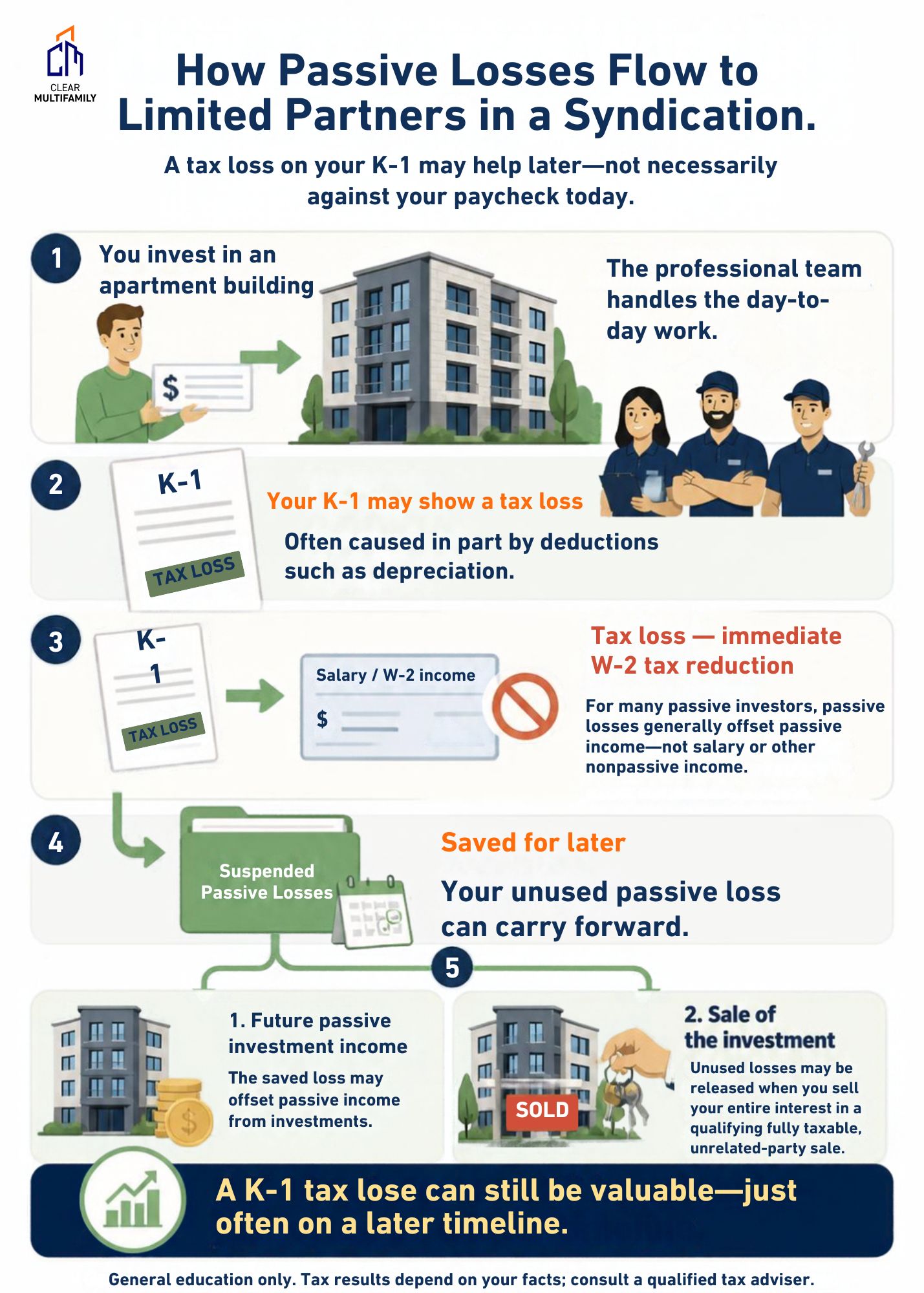
Every syndicated multifamily or commercial deal eventually sends investors a K-1 showing a loss — often a large one, driven by depreciation, cost segregation studies, and bonus depreciation on the acquisition.
New limited partners frequently assume that loss will offset their W-2 income or other active earnings the way a business loss might. In most cases, it won’t. The passive activity loss rules under Internal Revenue Code Section 469 were written specifically to stop exactly that kind of tax-shelter math, and limited partners in a syndication sit squarely inside the rules built to restrict it.
A syndication’s losses pass through to investors in proportion to their ownership share, reported annually on Schedule K-1. The loss itself is legitimate — it reflects real depreciation deductions the partnership is entitled to take.
The question Section 469 answers is not whether the loss exists, but what kind of income it’s allowed to offset.
Passive losses can only offset passive income. If a limited partner has no other passive income that year, the loss doesn’t disappear — it suspends, carrying forward until there’s passive income to absorb it or until a specific triggering event releases it.
For most LPs writing a check into someone else’s deal and taking no active role, that’s exactly the position they’re in.
Why Limited Partners Are Presumed Passive
Section 469(h)(2) creates a statutory presumption: an interest in a limited partnership is passive unless the holder meets one of a narrow set of material participation tests.
Where a general partner or an LLC manager can rely on any of seven material participation tests under the regulations, a true limited partner in real estate is restricted to two: participating more than 500 hours in the activity during the year or having materially participated in the activity in any five of the preceding ten years.
In practice, almost no passive syndication investor clears the 500-hour bar. That’s the point of the investment: you’re contributing capital, not time.
The LLC Wrinkle Most Investors Don’t Know About
Here’s a detail that matters more than most syndication marketing materials let on: the Section 469(h)(2) presumption technically applies to limited partnership interests, and a large share of modern syndications are structured as LLCs, not limited partnerships.
In Garnett v. Commissioner and again in Thompson v. United States, courts held that LLC and LLP members are not automatically treated as limited partners for this purpose, because LLC members are legally permitted to participate in management even if they choose not to. The practical effect is that an investor in an LLC-structured syndication may be able to apply all seven material participation tests, not just the two available to a true limited partner — a meaningfully lower bar to clear if you’re trying to establish active status.
In reality, this rarely changes the outcome for a passive capital investor who never intends to spend real hours on the deal. But it’s worth knowing which structure you actually hold, because it affects the analysis if you’re weighing whether increased involvement (site visits, approving major decisions, working with the sponsor directly) could shift your tax treatment.
It’s also worth noting the tradeoff: the same reasoning that helps LLC members avoid passive treatment has, in separate cases, exposed LLC members to self-employment tax on income that limited partners traditionally avoided. There’s no clean way to get the best of both rules simultaneously.
Two Gates Before Passive Loss Rules Even Apply
Passive activity treatment is actually the third hurdle a syndication loss has to clear, not the first. Basis limitations under Section 704(d) come first: you cannot deduct a loss that exceeds your basis in the partnership interest, and basis is generally your capital contribution adjusted for your share of income, loss, and distributions — non-recourse debt allocated to you can increase it, which is part of why syndications often show losses well beyond an investor’s cash outlay.
The at-risk rules under Section 465 apply next, limiting deductions to amounts you’re actually at risk of losing, which for most passive LP investors tracks fairly closely to their equity contribution unless the deal’s debt structure lets some liability count toward their at-risk amount.
Only after a loss survives both the basis test and the at-risk test does the passive activity rule get applied to it. A loss disallowed at either of the first two gates suspends under that specific rule and carries forward separately from any passive loss carryforward.
The Real Estate Professional Status
The other well-known escape hatch — real estate professional status under Section 469(c)(7) — is generally out of reach for syndication income specifically. Qualifying requires more than 750 hours and more than half of your personal service time spent in real property trades or businesses in which you materially participate.
Even an investor who qualifies as a real estate professional through their own direct holdings still has to separately establish material participation in each syndication to convert that specific activity’s losses to non-passive, unless they’ve made a valid election to group all rental activities together. That election is a real strategy for some investors, but it has to be made deliberately and applied consistently — it isn’t automatic.
Where the Losses Eventually Land
Suspended passive losses aren’t lost value — they’re deferred value, and they carry forward indefinitely against future passive income from any source, not just the same syndication. The full release happens under Section 469(g): when a limited partner disposes of their entire interest in the activity in a fully taxable transaction to an unrelated party, every suspended loss tied to that activity becomes fully deductible against any income, including the gain on the sale itself.
That’s typically the moment a syndication LP actually captures the tax benefit of years of accumulated depreciation — at the property’s sale or refinancing exit, not during the hold period.
A few structuring choices change this outcome. A 1031 exchange at the property level defers the gain but does not release the suspended losses tied to the old activity — they carry over.
The Bottom Line
For most limited partners in a syndication, the honest expectation should be that K-1 losses accumulate rather than offset current income, unless you have other passive income to absorb them, you or a household member independently qualifies as a real estate professional with a valid grouping election in place, or you’re evaluating an exit where the suspended losses will finally be freed.
That’s not a flaw in the investment — it’s the intended design of Section 469. Sponsors who market the tax benefits of a syndication should be describing deferred value, not an annual write-off against your salary, and investors evaluating a deal should ask directly whether they’ll have other passive income to use the losses against before assuming the K-1 loss will do anything for them this year.
Many investors we work with are both passive and active real estate investors like Linda.
If you would like unbiased advice on how to grow the value of your multifamily property, head over to www.clearmultifamily.com and check out our subscription service that gives you unlimited BOVs and up to 3 sales per year.
Clear Multifamily is a premium marketing platform that gets your multifamily properties sold for more money while saving 67–80% on commission.
This article is for general informational purposes and does not constitute tax or legal advice. Passive activity, at-risk, and basis rules are fact-specific — consult a CPA or tax attorney familiar with your full return before relying on any strategy described here.
Sources
- https://www.irs.gov/taxtopics/tc425
- Code Section 469 (Passive activity losses and credits limited) | Tax Notes — https://www.taxnotes.com/research/federal/usc26/469
- Can a Limited Partner Have Material Participation? (w/Examples) + FAQs | TaxShark — https://taxsharkinc.com/can-a-limited-partner-have-material-participation-w-examples-faqs/
- Passive Activity Loss Rules Every Real Estate Investor Should Know | REPSLog Blog — https://blog.reps-log.com/2026/07/30/passive-activity-loss-rules/
- Passive Activity Loss Rules: Members in LLC and LLP Are Not Limited Partners | Butler Snow — https://www.butlersnow.com/news-and-events/passive-activity-loss-rules-members-in-llc-and-llp-are-not-limited-partners
- 26 U.S. Code § 469 – Passive activity losses and credits limited | Cornell Legal Information Institute — https://www.law.cornell.edu/uscode/text/26/469