I recently had a transaction with a very seasoned investor of 25+ years named Tony. He had bought hundreds of rentals, developed land and worked in the industry most of his life.
However, this time Tony was doing a 1031 exchange- for the very first time.
“How do you invest for 25 years and never do an exchange?” I asked him. “Well, I just never sell, that’s all. I was following the Buy until your Die plan” Tony said.
This time though he got an offer he could not turn down though. Thankfully the 1031 exchange was there to help Tony on the tax bill when he sold, and he was happy that he was buying another property that was a great deal.
The funny thing is though that Tony still had a few questions, because, well experience is the best teacher and he was new at the 1031.
So let’s cover some basics and more challenging questions that often arise on a 1031 exchange.
The Basics
A 1031 exchange lets an investor defer capital gains and depreciation recapture tax on the sale of investment real estate by rolling the proceeds into replacement property.
Below are the questions that come up most often in our experience.
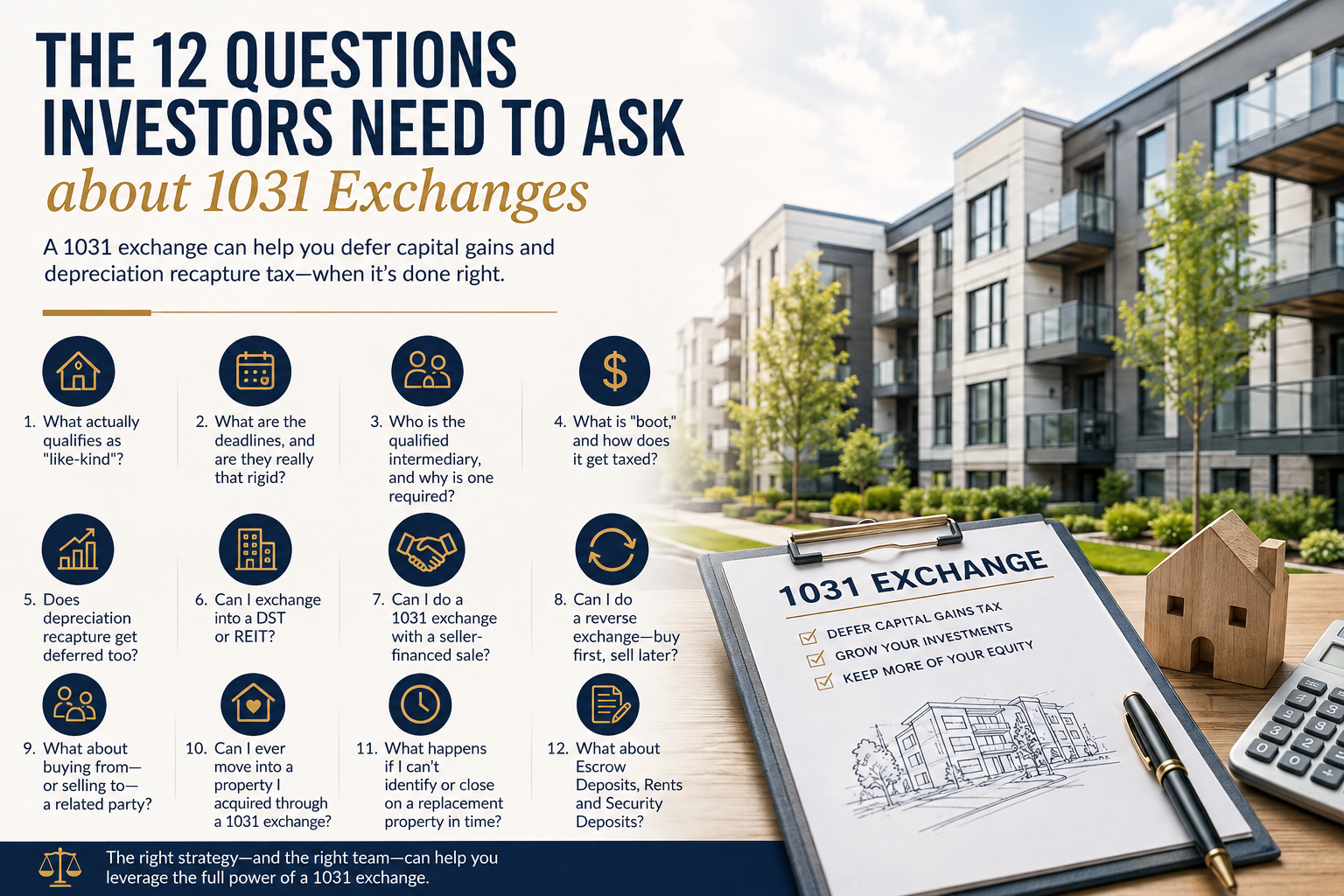
1. What actually qualifies as “like-kind”?
For real estate, the bar is low: any real property held for investment or business use is like-kind to any other real property held for investment or business use.
- A multifamily building can be exchanged for raw land, a retail center for an industrial warehouse, or a fractional DST interest for a fee-simple property.
- Personal-use property does not qualify — a primary residence or a second home used mainly for personal enjoyment falls outside Section 1031 entirely, regardless of what it’s exchanged for.
This is the biggest mis-conception that we commonly here- investors think if you sell apartments you must buy apartments, etc. Any real estate for any other real estate held for investment qualifies.
2. What are the deadlines, and are they really that rigid?
Yes. From the day the relinquished property closes, the investor has 45 calendar days to formally identify replacement property in writing to the qualified intermediary, and 180 calendar days total (or the tax filing deadline for that year, if earlier) to close on the replacement.
- Both clocks run concurrently and start the moment the first sale closes — not when the investor starts looking for a replacement.
- Neither deadline moves for weekends, holidays, or financing delays, and there is no general extension available outside of federally declared disaster relief.
- Most investors will start looking once they have the property they are selling firmed up while under contract, in order to give them more time to identify a replacement.
3. Who is the qualified intermediary, and why is one required?
A qualified intermediary (QI) is an independent third party who holds the sale proceeds, takes assignment of the purchase and sale agreements, and dispenses the money for the replacement property on the investor’s behalf, so the investor never has actual or constructive receipt of the cash.
- Touching the money directly — even briefly — disqualifies the exchange. The investor must have the QI set up at closing of the property being sold in the exchange, and not take possession of the money.
- The QI holds the money in an account on the investor’s behalf, and is typically paid a fee of $1,500-$2,500 or more depending on the size and complexity of the deal. (Some charge per property, so if you are purchasing a group of 20 separately deeded townhomes ask about the deal structure to save money)
- The QI cannot be the investor’s agent from the prior two years: that rules out the investor’s own attorney, accountant, real estate agent, broker, or employee, as well as family members and entities the investor controls.
4. What is “boot,” and how does it get taxed?
Boot is anything of value received in the exchange that isn’t like-kind real property — cash left over not used to buy replacement property, personal property, or a reduction in debt not offset by new cash invested.
- If an investor sells a property with a $500,000 mortgage and buys a replacement with only a $400,000 mortgage without contributing additional cash, the $100,000 difference is boot and is taxed as gain.
- To fully defer tax, the replacement property generally needs to be of equal or greater value and equal or greater debt (or offset with new cash) than the relinquished property.
5. Does depreciation recapture get deferred too?
Yes, as long as the exchange is fully deferred — full value reinvested, no boot received, and debt on the replacement equal to or greater than debt relieved on the sale.
- If the exchange is only partially deferred because of boot or a downsize in value, the recognized gain is treated as depreciation recapture first, taxed at the recapture rate, before any remainder is taxed as capital gain.
6. Can I exchange into a DST or REIT?
- A Delaware Statutory Trust (DST) interest is treated by the IRS as direct real property ownership for 1031 purposes, making it a common option for investors who want passive replacement property or need to place exchange proceeds quickly near the 45-day deadline.
- A REIT is different: REIT shares are securities, not real property, so a straight purchase of REIT stock does not qualify.
Where Exchanges Get Complicated
7. Can I do a 1031 exchange with a seller-financed sale?
Yes — this is one of the more misunderstood areas of exchange planning, but it is well-established and workable.
- The friction is that a promissory note the seller (exchanger) carries back is not like-kind property; on its own, a note is boot.
Option #1
- The simpler and more common approach is to exclude the note from the exchange entirely. The note is made payable directly to the seller, not to the qualified intermediary, and only the cash proceeds from the sale go into the exchange.
- The cash portion that’s reinvested in replacement property is deferred under Section 1031 as usual; the note itself is reported as an installment sale under Section 453, meaning the seller pays capital gains tax on the note’s principal only as payments are actually received over time, with the interest portion taxed separately as ordinary income.
- This keeps the two tax regimes cleanly separated and avoids disqualifying the exchange.
Option #2
- The second, more complex approach is to fold the note into the exchange itself. Here the note must be made payable to the qualified intermediary at closing — not to the seller — and then either sold to a third-party buyer at a discount for cash the QI can use to acquire replacement property, or applied by the seller as part of the purchase price on the replacement property (in effect, the seller becomes their own lender on the next deal).
- This route can defer tax on the full transaction, including the note, but it requires the note to be structured and directed correctly from the start; an investor who first takes personal receipt of the note and only later tries to contribute it to the exchange will generally lose the deferral on that portion of the deal.
- Either way, this needs to be built into the purchase and sale agreement and coordinated with the QI before the relinquished property closes — not decided after the fact.
Watch: Top 5 Questions Investors ask about 1031 Exchanges
8. Can I do a reverse exchange — buy first, sell later?
Yes, through a reverse exchange, where the replacement property is acquired before the relinquished property is sold.
- Because an investor cannot hold title to both properties simultaneously and still qualify, an exchange accommodation titleholder (typically an affiliate of the QI) takes and holds title to one of the properties for the duration of the exchange. The same 45-day identification and 180-day completion windows apply, just measured from the date the accommodation titleholder takes title.
- Reverse exchanges are more expensive and administratively heavier than a standard delayed exchange and should be set up before the replacement property purchase closes.
9. What about buying from — or selling to — a related party?
- Exchanges between related parties (family members, or entities in which the investor holds more than a 50% interest) are allowed but carry a two-year holding requirement on both sides of the trade.
- If either party disposes of the property within two years of the exchange, the deferred gain is generally triggered retroactively.
- Routing a related-party transaction through a qualified intermediary does not get around this rule — the IRS treats the substance of the transaction as controlling, not the paperwork.
10. Can I ever move into a property I acquired through a 1031 exchange?
Eventually, yes, but not immediately.
- The replacement property must first be held for genuine investment purposes — most practitioners look for at least two years of investment or rental use, with actual rental activity at fair market rent, before any conversion to personal use.
- Converting too soon undermines the investment-intent requirement that made the exchange valid in the first place.
- Investors who later convert a former exchange property into a primary residence and eventually sell it may also face a modified holding period and gain-allocation rules under Section 121(d)(10) before any home-sale exclusion applies.
11. What happens if I can’t identify or close on a replacement property in time?
If the 45-day identification window or 180-day closing window is missed, the exchange fails and the entire gain on the relinquished property becomes taxable in the year of sale, exactly as if no exchange had been attempted. There is no partial credit for having tried.
- This is the most common way exchanges fail in practice, usually because of financing delays or a replacement property falling out of contract late in the process — which is why experienced investors identify backup properties within the 45-day window even when they have a lead candidate under contract.
- What about Escrow Deposits, Rents and Security Deposits?
If you are an exchangor, when you enter into a contract to purchase a replacement property, an escrow deposit will be due.
There are two ways to handle this:
- Assign the contract to your QI right away, and then direct them to fund the escrow deposit for your replacement property.
- Fund the escrow from separate funds not part of the exchange. At closing, these funds would be returned to you because they are not part of the exchange.
Rents and Security Deposits
Since these are properties sold for investment purposes, commonly rents and security deposits need to be passed from a seller to a buyer.
- Commonly these are put onto the settlement statement at a closing
- Because these are considered operational income items, and not costs of the sale, they can be considered Boot in a 1031 exchange.
- To avoid triggering these amounts being treated as Boot, they should be handled separately off the settlement statement, direct from the buyer to the seller.
Getting off Scott free
Engaging in a 1031 exchange is a powerful way to continue to build wealth without triggering capital gain and depreciation recapture when selling a property.
While this information is intended to help our audience of investors, none of this replaces advice from a qualified intermediary and a tax advisor who can look at the specific facts of a transaction — and offered tailored advice to keep you away from triggering taxes and remain a happy investor.
CALL TO ACTION:
Many investors we work with are savvy deal makers and are looking to intelligently maximize their profits. If you are considering selling an investment property and would like to discuss the value, reach out to us today to get started.
Sources
1031 Exchange Timeline: The 45-Day and 180-Day Rules Explained — CPEC1031 — https://www.cpec1031.com/blog/1031-exchange-timelines-the-45-day-and-180-day-rules-explained
Related Party Exchanges — IPX1031 — https://www.ipx1031.com/related-party-exchanges/
Seller Carry Back & 1031 Exchanges — IPX1031 — https://www.ipx1031.com/seller-financing-combined-with-a-tax-deferred-exchange/
Seller Carry-back Notes and 1031 Exchanges — Exeter 1031 Exchange Services / Exeter Trust Company — https://exeterco.com/seller-carry-back-notes-and-1031-exchanges/
Can You Use Seller Financing in a 1031 Exchange? — theBrokerList Blog — https://blog.thebrokerlist.com/can-you-use-seller-financing-in-a-1031-exchange/
Impact of Depreciation Recapture on a 1031 Exchange — 1031 Specialists — https://www.1031specialists.com/blog-posts/impact-of-depreciation-recapture-on-a-1031-exchange
Can You Convert a 1031 Exchange Property into a Principal Residence? — FGG 1031 — https://blog.fgg1031.com/blog/can-you-convert-a-1031-exchange-property-into-a-principal-residence
Delayed 1031 Exchange – Exchange Timelines & Deadlines — IPX1031 — https://www.ipx1031.com/deadlines-and-identification-requirements/