
If you spend any time talking to a broad group of real estate investors, one thing will become clear: there is no one-size-fits-all.
The path to real estate success can be hugely varied, and what is a dream property for one investor can be a nightmare for the next.
I have a friend who is an industrial redeveloper in the San Francisco Bay Area. There, they can count on environmental remediation being needed on nearly every property they purchase, because tidal currents move the water table underneath the land mass, carrying contaminants common to older industrial properties across surrounding sites. They love taking on these challenging properties that many investors would never touch.
Today we’re reviewing a unique property type that may be a fit for some investors: Zero Cash Flow investments, or “Zeros.”
A Zero Cash Flow (Zero CF) Triple Net (NNN) investment is a niche but intriguing option for seasoned investors seeking tax benefits, passive income, and stable long-term returns.
Understanding Zero Cash Flow NNN Investment
Triple Net (NNN) Lease Basics
A Triple Net (NNN) lease is a lease agreement where the tenant is responsible for paying the property’s operating expenses — including real estate taxes, insurance, and maintenance — in addition to rent. This arrangement minimizes the landlord’s responsibilities, making it a popular choice for investors seeking passive income.
Zero Cash Flow (Zero CF) Explained
Zero Cash Flow properties are highly leveraged NNN investments where the rental income from the property exactly matches the debt service (loan payments), resulting in zero net cash flow to the investor during the loan term. Typically, these properties are leased to creditworthy tenants under long-term (15 to 25 year) leases, ensuring stable and predictable income to cover the debt.
Benefits of Zero Cash Flow NNN Investments
Tax Advantages
- Depreciation: Investors can depreciate the property, reducing taxable income.
- Interest deductions: The interest component of the debt service is tax-deductible, providing significant tax relief.
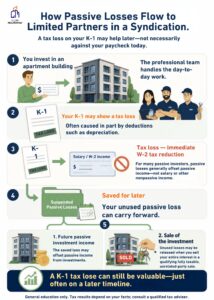
Zero properties provide a source of depreciation and interest expenses that an owner can use to offset income received from other qualifying investment properties, thus lowering their overall tax obligation. These benefits are generally available within the first 10 to 15 years of ownership.
Long-term leases: These properties feature long-term leases (15 to 25 years), providing stability and predictability.
Opportunity in a tough market: Securing financing during volatile markets can be difficult, as risk goes up. Acquiring a zero property can ease the financing challenge by requiring a smaller percentage down payment compared to a traditional commercial transaction, because a secure tenant backs the loan.
Equity Buildup
As the tenant pays down the mortgage over time through debt amortization, the investor builds equity in the property, which can be substantial by the end of the loan term.
Risks and Considerations
Watch: WHAT is a Zero Cash Flow, Triple Net Investment Property?!
Lack of Immediate Cash Flow
Investors receive no net cash flow during the loan term, which may be a drawback for those needing immediate income. The investor should keep a reserve for loan payments in case of an unlikely default, or a repeat of pandemic-era disruptions.
Tenant Credit Risk
The investment’s success heavily relies on the tenant’s ability to meet lease obligations, and tenant default can lead to financial challenges. This lease structure has historically been common with drugstore chains, which is a useful reminder that even long-term, creditworthy-seeming tenants can run into financial trouble over the life of a lease.
Tricky Taxes
The biggest benefit of a zero cash flow deal — the tax break — can also be the most challenging part of owning this type of asset. Typically, 10 to 15 years into the investment, the annual depreciation falls below the yearly lease payments, making the investment appear profitable on paper. This situation is called phantom income: income that is taxable but not actually received, which can cancel out the tax benefits the zero cash flow structure once provided. Investors must have cash flow available from other sources, or other passive deductions in later years, to balance out this tax obligation, since the property itself won’t provide cash flow.
Who Zero Cash Flow NNN Investments Are Best Suited For
1031 Exchange Buyers
Zeros are most attractive for 1031 exchange buyers who need to replace their investment but have little to no equity. This strategy can replace a large amount of debt in a tight timeline without significant start-up costs. 1031 exchange buyers with equity may also consider acquiring a zero, since it allows them to cash in on the paydown readvance from the loan and receive a significant amount of tax-free equity.
Paydown Readvance
Perhaps the biggest benefit for investors in Zero properties is the paydown readvance feature. This feature allows the borrower to pay the balance of the loan down in full at any point during the loan term. If a borrower elects to use the paydown feature, the readvance then allows the borrower to instruct the lender to refinance the loan back to the balance and terms it was at prior to the paydown.
If the property is part of a 1031 exchange, the buyer can use this option to purchase the property while fulfilling the debt and equity requirements of their exchange, then later pull out some of their equity tax-free — not unlike the flexibility investors gain through a Drop and Swap structure. For example: say an owner just sold their property for $30,000,000, with $25M in equity and $5M in debt. The owner finds a zero cash flow property they want to purchase for $30M, using $3M as equity and assuming $27M in debt to cover their debt requirement. To meet their equity requirement, they apply all $25M in cash to purchase the zero cash flow property.
Before closing, the owner notifies the lender that they want to use the paydown readvance feature. They put down $25M cash toward the purchase, paying the loan down to only $5M. After closing, the debt is readvanced to the original $27M, and the owner pulls out $22M in tax-free proceeds.
Conclusion
Zero Cash Flow NNN investment real estate offers a unique blend of stability, tax advantages, and long-term equity growth, appealing to specific investor profiles. Investors considering this strategy should conduct thorough due diligence and consult with financial and tax advisors to ensure it aligns with their financial goals and risk tolerance.
Looking to diversify your investments? We can refer you to professionals who specialize in unique assets in any state in the US. Call us for a confidential consultation.