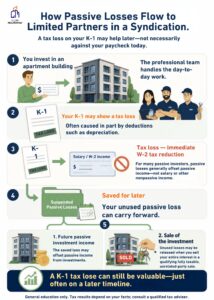
Real estate investing offers plenty of benefits, from inflation protection to leverage and cash flow. But the biggest benefit might be the tax advantages real estate affords, and one of the most powerful is depreciation.
Depreciation lowers your tax burden without any outlay of cash. The catch is that many new and first-time investors are surprised by a tax bill for depreciation recapture when they eventually sell. With some planning, and often a 1031 like-kind exchange, that pain can be eased considerably.
What Is Depreciation?
Depreciation is one of the key tax benefits of commercial real estate investing. It’s essentially a non-cash expense that lowers the tax burden on your real estate income.
For example, say an investor buys a multifamily building for $5,000,000. If the land is worth $1,000,000, the remaining $4,000,000 value of the building can be depreciated over 27.5 years, letting the owner expense $145,454 a year against operating income without spending a dime.
If this property had a 5% cap rate, its $250,000 in annual operating income would be reduced for tax purposes to $104,546 ($250,000 minus $145,454), lowering the tax burden by almost 60%.
Land: $1,000,000
Building: $4,000,000
Total investment: $5,000,000
Net operating income (5% cap rate): $250,000
Depreciation ($4,000,000 / 27.5): ($145,454)
Income after depreciation: $104,546
Depreciation Recapture
As good a deal as that is while you own the property, the IRS comes back for its share of that non-cash expense when you sell, in the form of a recapture tax.
Continuing the example, say the property sells for $6,000,000 after five years. That produces a total gain of $1,727,270. Of that, $1,000,000 is treated as a capital gain (assuming the property was held more than a year), while the remaining $727,270, which reflects five years of $145,454 in annual depreciation, doesn’t qualify for long-term capital gains treatment. It’s subject to depreciation recapture at a rate of 25%.
That recaptured amount isn’t taxed as a capital gain. It’s taxed as if it were ordinary income.
Original purchase: $5,000,000
Total depreciation: ($727,270)
Adjusted basis: $4,272,730
Sale price: $6,000,000
Capital gain: $1,000,000
Depreciation recapture: $727,270
Total gain: $1,727,270
Depreciation Recapture in a 1031 Exchange
When you use a 1031 like-kind exchange, both the capital gain and the depreciation recapture are deferred and rolled into the basis of your new property. The 1031 exchange is commonly used, but it’s fairly complex, with detailed requirements including a third-party custodian to hold sale proceeds in escrow and disburse them for the replacement purchase.
To qualify for 1031 treatment, your existing property must be exchanged for a like-kind property, and two deadlines apply. You must identify the replacement property within 45 days of closing the sale on your existing property, and you must close on that new property within 180 days of the original sale.
There are plenty of nuances beyond these basics, so it’s worth working with professionals experienced in 1031 exchange transactions.
Bottom Line
Many first-time and new real estate investors understand the tax benefits of depreciation, but they’re often surprised by depreciation recapture when it comes time to sell. A 1031 like-kind exchange can defer both the capital gain and the more expensive depreciation recapture, keeping more of your equity working for you.